
September 1400: rebellion begins at Ruthin
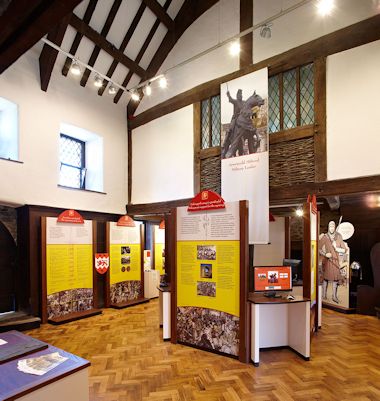
Owain Glyndŵr's rebellion against English rule broke out at Ruthin in September 1400, and over the following years it spread across Wales, fed by deep causes of unrest that had been building long before the first blow was struck. What began as a local quarrel grew into a national uprising with Glyndŵr proclaimed at its head, and for a few extraordinary years Wales had its own prince, its own diplomacy and its own parliament. The story matters everywhere in Wales, but nowhere holds it closer than Machynlleth — the small Dyfi Valley market town where the rebellion reached its political high point, and where you can still stand on the street most closely associated with his parliament.
1401: victory at the Battle of Hyddgen
In the summer of 1401 Glyndŵr's forces defeated the King's army at the Battle of Hyddgen, fought in the foothills of Pumlumon, the great upland massif south of Machynlleth. It was a defining victory, and it is the centrepiece of the striking mural by the Scottish artist Murray Urquhart, painted in 1912–14 inside the Parliament House, which depicts scenes from Glyndŵr's life. Those same lonely hills are walking country today: Glyndŵr's Way, the 135-mile National Trail from Knighton to Welshpool named in his honour, passes through Machynlleth and climbs to its highest point at Foel Fadian (510 m), with views down the Dulas valley to the town and the sea. Few battlefield landscapes in Britain remain so unchanged.
1404: crowned Prince of Wales at Machynlleth
The year 1404 made Machynlleth a capital. Glyndŵr summoned his Welsh parliament to the town and was crowned Prince of Wales here, near the site of the Parliament House, before envoys from Scotland, France and Spain — foreign recognition that turned a rebellion into a state in the making. The building now called the Parliament House on Heol Maengwyn is a late-medieval town house tree-ring dated to around 1470, a generation after the event, but it stands on or near the site traditionally associated with the parliament, and it houses the town's free exhibition on Glyndŵr's life and times. It is the natural first stop for anyone following the story — see our full Parliament House visitor page, and the wider sweep of the town's past on the history page.

1406: the Pennal Letter
Glyndŵr held his final parliament at Pennal, a village about four miles west of Machynlleth, and it produced one of the most remarkable documents in Welsh history. The Pennal Letter, signed by Glyndŵr at Pennal in Lent 1406 and addressed to King Charles VI of France, set out a vision of an independent Wales with its own church and its own universities — a national programme centuries ahead of its time. The original is held in the Archives Nationales in Paris; a facsimile is displayed in Pennal's church of St Peter ad Vincula, which was rebuilt using stones from the first-century Roman fort site at Cefn Caer, and another at the Parliament House in Machynlleth.
1405–1415: how the rebellion ended
1404 was the high point; what followed was a long reversal. In February 1405 Glyndŵr set his name to the Tripartite Indenture, an agreement to divide England and Wales three ways, with Wales reaching east to the Severn and the Mersey. French troops landed at Milford Haven under a formal treaty, but Paris turned towards peace and most had gone by the year's end. Prince Henry then changed tactics, using the crown's castles for a patient economic blockade rather than seeking battle. Aberystwyth Castle was recovered in 1408 and Harlech surrendered through the cold winter into 1409, and with it went Glyndŵr's family: his wife Margaret and two of his daughters, Catrin among them, were taken to the Tower of London, where all had died by 1413.
Glyndŵr escaped the fall of Harlech disguised as an old man, raided into Shropshire in 1410 and near Brecon in 1412 — then vanished from the record. He was never captured or killed, he ignored repeated offers of a royal pardon, and he is presumed to have died around 1415; nobody knows where he lies. Walk the country he fought over on Glyndŵr's Way, or read the wider story on our history page.
Why Machynlleth claims him
Glyndŵr has outlasted almost every other figure in Welsh history. He came second only to Aneurin Bevan in the 100 Welsh Heroes poll of 2003–04; stamps bearing his likeness were issued in 1974 and 2008; north Wales's regional rugby side plays as RGC 1404 after the year he became Prince of Wales; and a long campaign, taken up by Dafydd Wigley in 2021, wants 16 September made a Welsh public holiday. Machynlleth's memorial is quieter and, to our mind, finer: a five-metre slate monolith from Penrhyn Quarry, designed and cut by the sculptor and calligrapher Ieuan Rees, standing in the grounds of Y Plas. It was unveiled on 16 September 2000, six hundred years to the day after Owain was proclaimed Prince of Wales; the top carries his gilded Great Seal, ringed with “Owain Glyndŵr Tywysog Cymru Prince of Wales”, and the plinth an englyn by the local poet Dafydd Wyn Jones. The town's claim rests on one year, 1404, when a rebellion briefly became a government here.
Glyndŵr Day: 16 September
Owain Glyndŵr Day falls on 16 September each year, and around it runs Gŵyl Glyndŵr, a week-long, Wales-wide cultural festival celebrating his legacy — with Machynlleth's Owain Glyndŵr Centre as the town's focal point for the annual mid-September celebrations. It is a fine time to visit: the exhibition, the Urquhart mural and the town's medieval street pattern all mean more when the flags are out. The events page lists what else is on through the year.
Practical Information
The Parliament House (Canolfan Owain Glyndŵr), Heol Maengwyn, SY20 8EE, is run by a volunteer-led charity and is open Wednesday, Friday and Saturday, 10.30am–3.30pm; admission is free, with donations welcome. Caffi Glyndŵr is open daily 9am–4.30pm, and there is a bookshop inside. To follow the trail to Pennal, the G21 bus runs from Machynlleth via Pennal towards Aberdyfi and Tywyn — see getting around. Walkers can pick up Glyndŵr's Way directly from the town.
 Day trips