
The building and the 1404 parliament
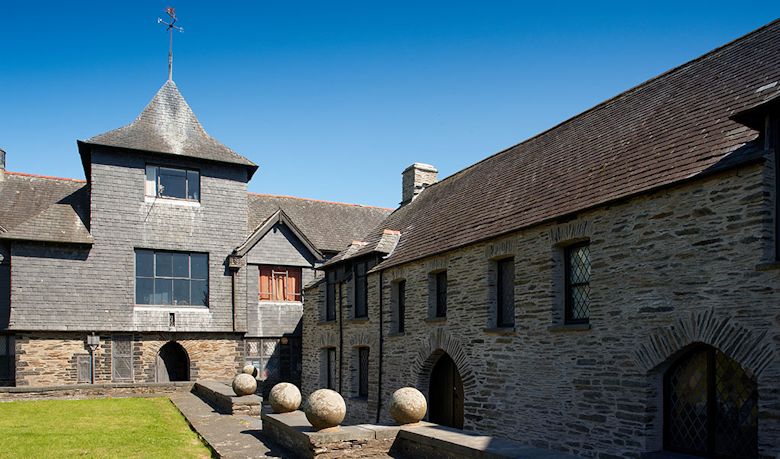
Halfway along Heol Maengwyn stands one of the most evocative buildings in Wales. In 1404 Owain Glyndŵr summoned his Welsh parliament to Machynlleth and was crowned Prince of Wales here, before envoys from Scotland, France and Spain. The stone-and-timber hall now known as the Parliament House has been tree-ring dated to around 1470 — a generation after that great year — but it stands on or near the site traditionally associated with the parliament, and it is quite possible that it incorporates fabric from the building that stood here in Glyndŵr's day. Today, following extensive restoration, it serves as a national heritage centre devoted to Glyndŵr's life and vision, known in Welsh as Canolfan Owain Glyndŵr. Whatever the dendrochronology says, standing in the hall where Wales remembers its last great act of independence remains a quietly powerful experience — and it costs nothing.
Inside: exhibition, timeline and the Urquhart mural
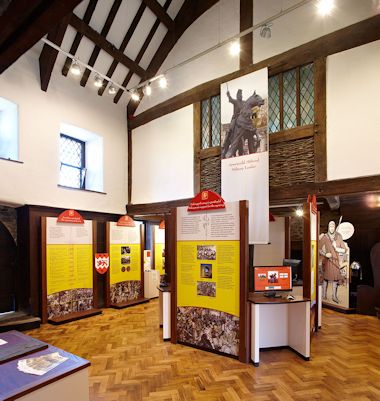
The centre houses an interactive exhibition covering Owain Glyndŵr's life and vision, together with the history of the period. His rebellion, which began at Ruthin in September 1400, is traced in a timeline that also explains its context — the causes of unrest in Wales that led to the rising against England. The artistic showpiece is a striking mural by the Scottish artist Murray Urquhart, painted between 1912 and 1914, depicting scenes from Glyndŵr's life including his victory over the King's army at the Battle of Hyddgen in 1401, fought in the Pumlumon foothills south of the town. More of the wider story — and what else survives from medieval Machynlleth — is on our town history page.
The Pennal Letter, broadsword and banners
Among the exhibits is a facsimile of the Pennal Letter, sent by Owain Glyndŵr to King Charles VI of France in 1406 — signed at nearby Pennal, where Glyndŵr held his final parliament, and proposing an independent Welsh church and universities for Wales (the original is kept in the Archives Nationales in Paris). Around it are replicas of medieval costume and artefacts, a replica broadsword, and colourful banners similar to those that would have been carried into battle — vivid props that make the period real for younger visitors especially. School visits are welcomed, and rooms in the building can be hired.
Saved by David Davies: 1906–1912
The building owes its survival to David Davies of Llandinam, who bought it in 1906 and had it carefully restored; it reopened on 20 February 1912 as an institute for the town. The Parliament House was Grade II listed in 1990, and the adjacent Glyndŵr Institute of 1911 is Grade II listed in its own right. Today the centre is run by a volunteer-led charity, and its bookshop — Siop Lyfrau'r Senedd-dy, run by Pen'rallt Gallery Bookshop — is one of the town's homes of Welsh-language books. Time your visit for a Wednesday and you will step out of the medieval hall straight into the Wednesday market, which has filled Maengwyn Street under its 1291 charter for more than 730 years.
The architecture: a late-medieval hall-house
Look past the story for a moment and the building itself is remarkable: a substantial and unusually complete hall-house, set parallel to the street rather than gable-end to it. It has a four-unit plan — a storeyed outer room of two bays, a two-bay open passage between partition trusses, a three-bay open hall with a partition at the dais end, and a storeyed inner room of two bays — which is the standard grammar of a high-status Welsh late-medieval house. The carpentry is fine work. Purlins and ridge are tenoned into the trusses, the moulded purlins carry two tiers of windbraces, the upper-end truss forms a shallow canopy over what would have been the top table, and the principal rafters are unusually shaped, or “extruded”, to take a tenoned collar. Tree-ring dating puts the felling of the timber at 1470. The rubble exterior you see from Heol Maengwyn is much later — an Edwardian interpretation of how a fifteenth-century building ought to look, probably by the architect Frank Shayler, carried out during the 1906–12 restoration. So: a genuine medieval hall in an Edwardian coat, on the site Wales remembers. The clock tower of 1874 completes the town's set-piece buildings; more on our history page.
Bookshop, Caffi Glyndŵr and school visits
The centre is more than an exhibition. Siop Lyfrau'r Senedd-dy, the bookshop run inside the hall by Pen'rallt Gallery Bookshop, trades during the Senedd-dy's visiting hours — Wednesday, Friday and Saturday, 10.30am to 3.30pm. Caffi Glyndŵr, by contrast, is open every day from 9am to 4.30pm, serving snacks, main meals and homemade cakes with regular vegetarian options and local produce where it can get it; you can ring the caffé directly on 01654 701539, and it is one of the town's better-value lunches whether or not you come for the history. Groups can be accommodated outside normal opening hours by prior arrangement — email [email protected] — and school visits are welcomed during term time on the same basis, which is where the replica broadsword, banners and costume earn their keep. Rooms in the building are available to hire for classes, social events and meetings. Admission stays free, with donations towards the charity gratefully received, and the whole thing runs on volunteers. The eat & drink page covers the town's other cafes.
Practical Information
Parliament House / Canolfan Owain Glyndŵr, Heol Maengwyn, Machynlleth SY20 8EE. The Parliament House is open Wednesday, Friday and Saturday, 10.30am–3.30pm; admission is free, with donations welcome. Caffi Glyndŵr is open daily, 9am–4.30pm. The centre is in the heart of town, a short walk from the clock tower and around five minutes on foot from the railway station; the Maengwyn Street pay-and-display car park is close by. As a volunteer-run venue, hours can occasionally change — check canolfanowainglyndwr.org before making a special journey.
 Day trips