
Please read first: CAT is no longer a walk-up attraction

For decades, guides like ours (this one included) described the Centre for Alternative Technology as a visitor centre open seven days a week. That is no longer true. Facing financial pressures, CAT stopped walk-up day admissions in 2023, and the site now opens for pre-booked visits only — residential and short courses, events, guided group tours, school, college and university visits, and B&B guests. There is no turning up on the day, and the café (fully vegetarian) serves pre-booked groups rather than passing trade. If you arrive in Machynlleth hoping to drop in, you will be turned away at the gate — so book through CAT's own website before you travel. For attractions you can simply turn up to, see our things to do page and the underground adventures at Corris, a couple of miles further up the same road.
Founded 1973 in the Llwyngwern quarry
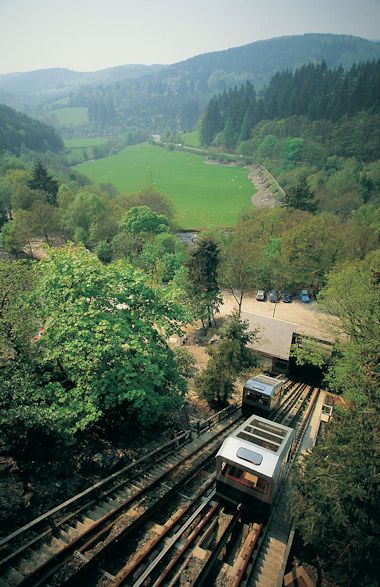
CAT was founded in 1973 by Gerard Morgan-Grenville as the National Centre for Alternative Technology, in the disused Llwyngwern slate quarry at Pantperthog, 3 miles north of Machynlleth — a quarry once served by the Corris Railway. It grew out of the early-1970s ferment of Small Is Beautiful, Blueprint for Survival and The Limits to Growth: a community of engineers and idealists testing wind, water and solar power on a rainy Welsh hillside long before anyone spoke of a climate emergency. Half a century on, the charity (no. 265239) occupies a 7-acre core site within 24 acres of gardens, woodland and displays demonstrating practical solutions for sustainability — renewable energy, eco-building, organic growing — and runs curriculum-based education for visiting schools, colleges and universities, much as it always has, only now by arrangement.
The cliff railway and the WISE building
Two structures sum up CAT's inventiveness. The first is the cliff railway: a water-balanced funicular opened in May 1992, 53 m long on a 57% gradient, in which the weight of water shifted between the two carriages does the lifting — no engine required. It remains one of the site's best-loved features, though we cannot confirm whether it is currently carrying passengers, so treat a ride as a bonus rather than a promise and check when booking. The second is the WISE building, completed in 2010: its 500mm hempcrete walls and a 320-tonne rammed-earth lecture theatre won a RIBA Award in 2011, and it stands as a full-scale demonstration of the low-carbon construction the centre teaches. Serious students go further still — CAT's Graduate School of the Environment runs postgraduate degrees from the site, drawing students from across the world to the Dyfi Valley, itself the heart of Wales's UNESCO Biosphere.
Cynefin: rebuilding for the next fifty years
CAT is now partway through Cynefin, a £25.3m redevelopment of the quarry site — the biggest investment in its history — reshaping how it hosts learners, researchers and visitors. The events calendar continues meanwhile: the annual CAT Conference takes over the site each August with talks, tours and workshops (it ran from 21 to 23 August in 2026), and short courses carry on through the year — recent listings have run from household renewables to timber framing. It all makes CAT a place you plan a trip around rather than stumble upon — and if a course or conference brings you here, Machynlleth makes a fine base, with everything from a Georgian coaching inn to campsites covered on our where to stay page and the town's cafes and restaurants on eat & drink.
Studying at CAT: the Graduate School and the short courses
The teaching is now the point of the place. CAT's Graduate School of the Environment runs taught master's programmes from the quarry site: Sustainability and Adaptation, Green Building and Sustainability in Energy Provision and Demand Management, validated by the University of East London, alongside Sustainable Food and Natural Resources, Sustainability and Behaviour Change and Sustainability and Ecology, validated by Liverpool John Moores University. Modules can be taken on site — lectures, seminars, workshops and hands-on practical sessions — or by distance learning, and CAT suggests roughly 18 months full-time or about three years part-time for the MSc, with home tuition recently listed in the region of £9,800. Below the degrees sit the short courses, generally one to four days: recent listings have included introductions to household renewables and heat pumps, timber-frame building, ecological assessment, sustainable allotment management, building a small wind turbine and building a tiny house. The popular ones sell out, so book early and check current dates and prices on cat.org.uk.
What Cynefin would mean for visitors
Cynefin is being delivered in stages as funding is secured, which explains the awkward position visitors find themselves in. CAT describes a first phase of roughly £3m, a little over half of it from the Mid Wales Growth Deal with match funding from several trusts and from CAT's own supporters, going into the Quarry Cottages as group accommodation for around 30 guests, a retrofit of the Straw Bale Theatre as a learning space, and work on the WISE building's solar performance and event rooms. It is the second phase that would reopen the quarry as a full visitor attraction, with a renewed arrival experience, a restored water-balanced funicular and reimagined gardens. Timings depend on approvals and further fundraising, so there is no date to plan a family day out around yet — for now, see family days out for alternatives, and check CAT's own news pages before assuming anything has changed.
Practical Information
CAT is at Pantperthog, Machynlleth (charity no. 265239), 3 miles north of the town off the A487; the T2 bus between Aberystwyth and the north stops at Pantperthog and the fflecsi bookable minibus covers the Dyffryn Dulas area (see getting around), while Sustrans National Cycle Network Route 8 runs from Machynlleth station right up to the entrance — well under half an hour by bike, or about an hour on foot. There is on-site parking, including accessible spaces, and EV charging. Visits must be pre-booked — courses, events, groups, students and B&B guests only; there is no walk-up admission and no drop-in café service. Booking, course dates and prices are on CAT's own website (cat.org.uk). Cyclists and walkers note: the Dyfi Bike Park at Esgair Forest is close by at Pantperthog too — see mountain biking — and the wider valley's trails, from riverside walks to Glyndŵr's Way, are open to everyone all year. Getting to Machynlleth itself, by the scenic Cambrian Line or by road, is covered on getting here.
 Day trips